Article
Jan 31, 2026
Why the U.S. Stock Market Fell and How Investors Should Navigate (2026)
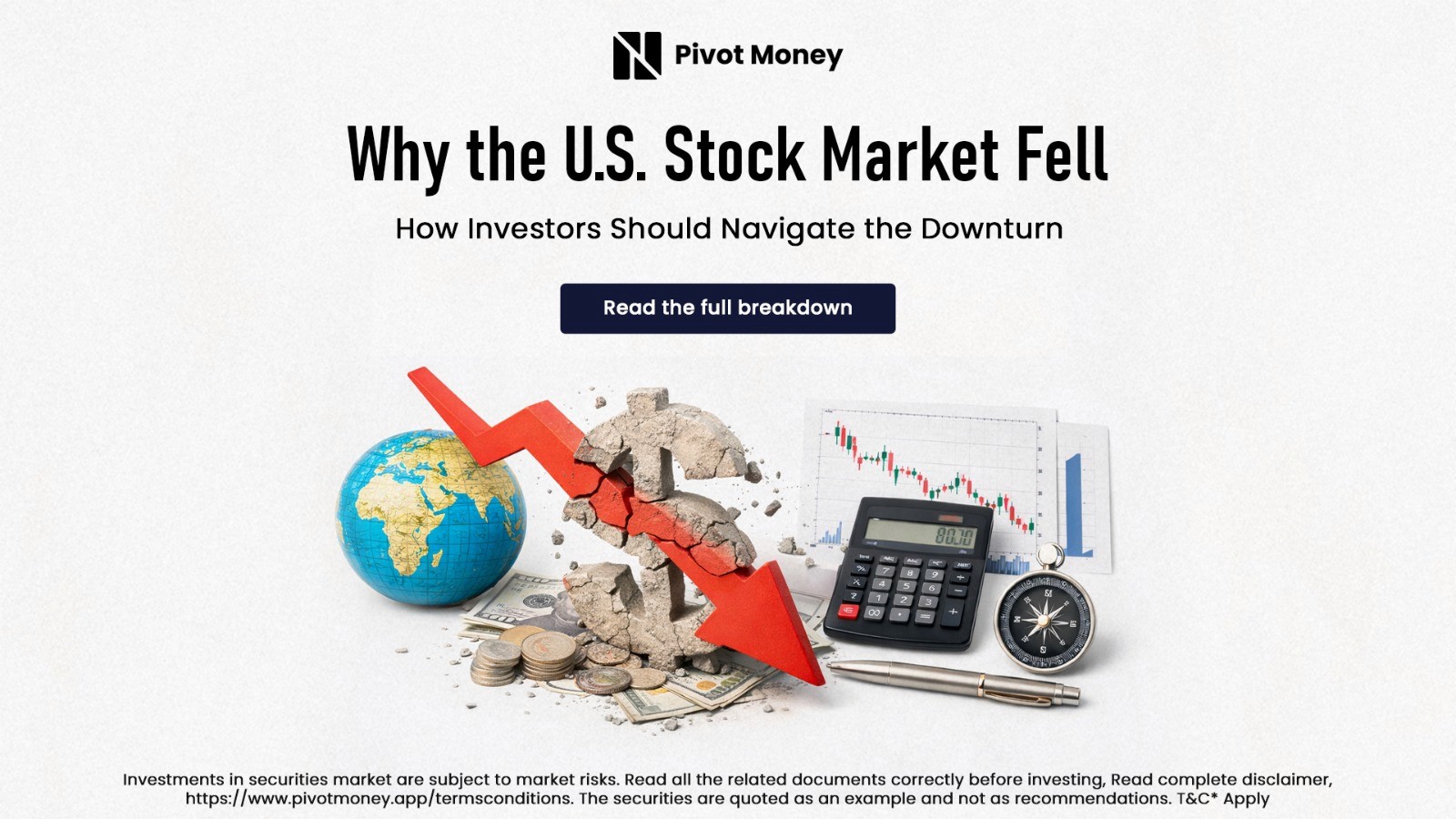
How Long-Term Investors Should Navigate the Downturn (2026)
Over the last 12–18 months, major U.S. equity indices have pulled back meaningfully from their recent highs.
• S&P 500: Down approximately 8–15% from recent peak levels
• Nasdaq 100: Sharper drawdowns of 15–25% at recent lows, driven by growth-stock repricing
• Market breadth: Weakening beyond just “Big Tech”
This decline has been relatively broad-based, impacting both growth and value stocks across sectors.
But this is not a systemic collapse.
Historically, U.S. equity markets have experienced corrections of around 10–15% roughly every 1–2 years, and 20%+ drawdowns every several years as part of normal market cycles. What we are seeing is a repricing phase, not a breakdown of the financial system.
The real risk for investors is not volatility, it’s misreading volatility.
The 5 Structural Reasons Behind the Decline
1. Slowing Growth Expectations
U.S. economic data since late 2024 shows moderation:
Consumer spending growth cooling from high-single-digit levels toward low-single-digit growth
Manufacturing PMI hovering near contractionary levels
Corporate earnings growth expectations revised down from double-digit forecasts to mid-single-digit consensus estimates
Markets price the future, not the present. Even modest growth downgrades can trigger sharp valuation resets.
2. The “Higher for Longer” Interest Rate Reality
From 2009–2021, U.S. investors lived in a near-zero interest rate world.
In 2025–26:
Policy rates have remained broadly in the 4.5–5% range
Risk-free Treasury yields continue to offer around 4% or higher returns
This creates two pressures:
Higher borrowing costs compress corporate margins
Equities must compete with more attractive fixed-income yields
Result: Valuation multiples contract, especially for long-duration growth stocks.
3. Inflation Hasn’t Fully Disappeared
While headline inflation has cooled significantly from the 2022 peak near 9%, it has remained around the 3% range, above central bank targets.
Persistent inflation:
Erodes real consumer purchasing power
Raises wage and input costs
Limits how aggressively central banks can cut rates
Even “sticky” inflation near 3% is enough to cap market optimism.
4. Global & Geopolitical Risk Premium Has Risen
Compared to 2015–2019, today’s global environment includes:
Ongoing geopolitical conflicts
Trade realignments and supply-chain restructuring
Fragmentation between major economic blocs
Markets respond by demanding a higher risk premium, which translates into lower equity prices — even if underlying fundamentals remain intact.
5. Technical & Institutional Selling Pressure
Once key index levels break:
Passive funds rebalance
Institutional investors reduce exposure
Algorithmic and systematic trading can amplify downside moves
These are largely mechanical effects, not judgments on long-term economic health — but they can accelerate short-term declines.
How Investors Should Respond: A Revised Playbook
While market declines can be challenging, they also create opportunities for disciplined investors. Here are practical strategies to navigate volatility:
#1: Re-anchor to Time Horizon, Not Headlines
If your goal is 10+ years away, short-term volatility is noise, not a signal.
Long-term equity returns are driven by:
Earnings growth
Productivity
Compounding
Not quarterly sentiment shifts.
#2: Rebalance, Don’t React
A falling market often pushes portfolios away from intended allocations.
Disciplined rebalancing:
Forces buying when prices are lower
Reduces emotional decision-making
Improves long-term risk-adjusted returns
#3: Diversify Beyond One Market Cycle
The U.S. has outperformed for over a decade. That dominance is unlikely to be linear forever.
Global diversification helps:
Smooth volatility
Capture differing economic cycles
Reduce dependence on a single country’s policy path
A balanced portfolio across:
U.S. equities
Indian equities
Global ex-U.S. markets
Fixed income
is structurally more resilient.
#4: Keep Systematic Investing Intact
For SIPs / dollar-cost averaging:
Market declines lead to lower average acquisition costs
Long-term unit accumulation improves outcomes
Stopping SIPs during downturns has historically destroyed long-term value.
#5: Avoid the Market-Timing Trap
Consistently predicting market tops or bottoms is extremely difficult — even for professional fund managers.
Historical market data and long-term simulations show that investors who miss just a handful of the best-performing days over extended periods can experience materially lower long-term returns, often 30–50% lower than staying consistently invested.
Market timing requires being right twice: when to exit and when to re-enter. Most investors fail at one or both.
A rules-based, consistent investment approach has historically outperformed prediction-driven decisions over time.
The Pivot Money View
Market corrections are not warnings to exit — they are reminders to review strategy.
At Pivot Money, we encourage investors to:
Focus on asset allocation, not forecasts
Maintain diversification across geographies
Invest with rules, not reactions
Volatility is temporary.
A disciplined process is permanent.
The Takeaway
The recent U.S. market decline reflects:
✔ Slower growth expectations
✔ A higher interest rate reality
✔ Persistent inflation
✔ Elevated global risk
Not a collapse of capitalism or long-term equity investing.
Investors who stay diversified, systematic, and long-term oriented have historically been rewarded, not punished, during such phases.