Article
Jun 14, 2026
The 400-Year-Old Investing Lesson Behind the SpaceX IPO
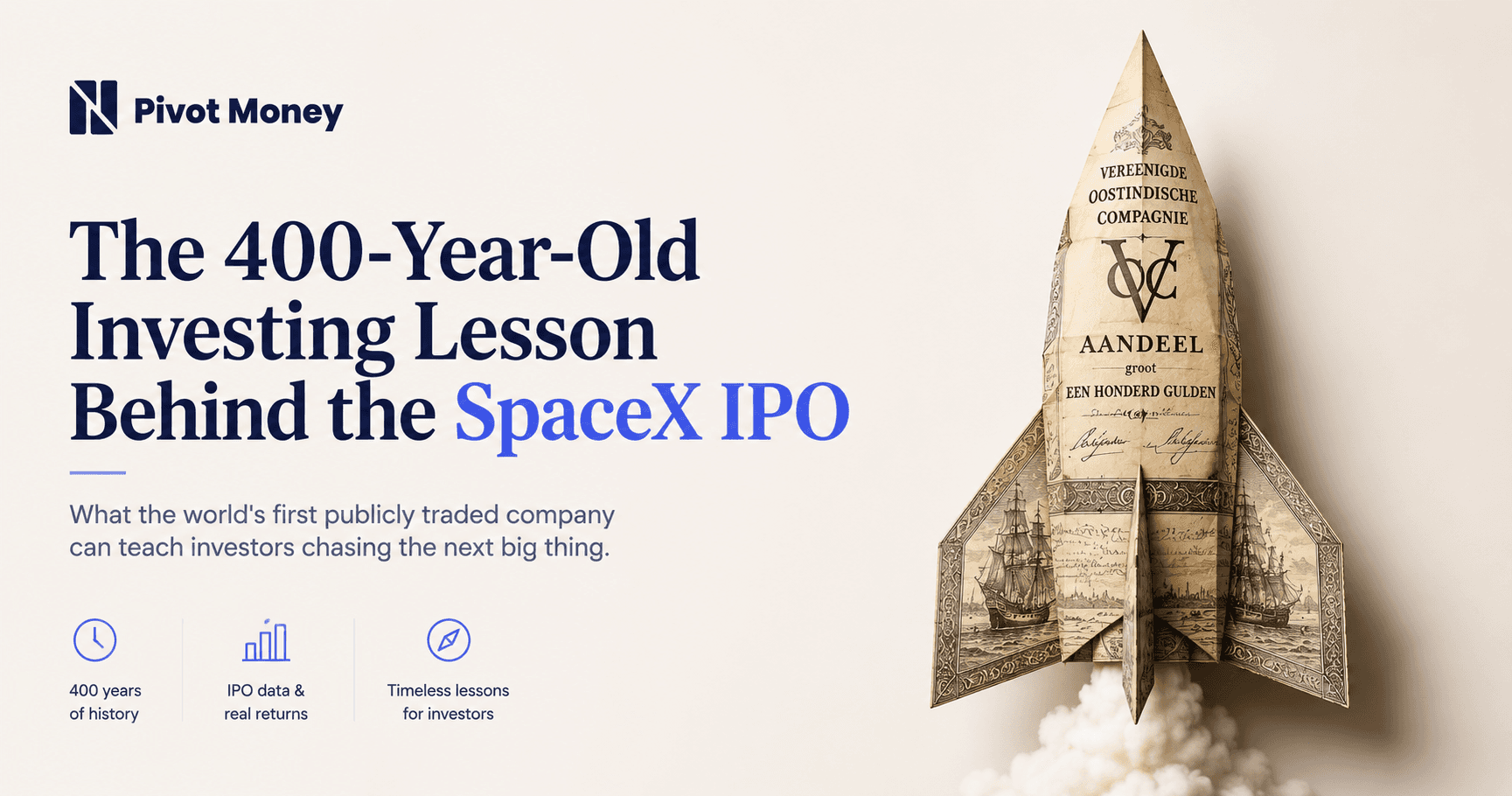
What the world's first publicly traded company can teach investors chasing the next big thing
SpaceX is one of the most talked-about companies on earth. It reshaped space travel, built the Starlink network, and has generated enormous paper wealth for early backers. With reports of it heading toward one of the largest IPOs in Wall Street history, investors everywhere — including many NRIs — are asking the same question:
"Should I get in as soon as I can?"
A 400-year-old story suggests a more useful question to ask first.
The first company the public could ever buy
In 1602, the Dutch East India Company — known by its Dutch initials, VOC — became one of the first companies in history to sell shares to the public, and in doing so helped create the Amsterdam Stock Exchange. For the first time, ordinary investors could buy into global trade without ever boarding a ship.
Here's the part most people get wrong: the VOC was not a bubble or a paper promise. It was a genuine business backed by fleets, trade routes, military power, and government support. And yet, despite all of that, the stock took roughly three decades to double. A real frontier, a revolutionary company — and a slow, patient grind for the people who bought in.
That history is exactly why market analyst JC Parets recently argued the better comparison for SpaceX isn't another hot tech listing — it's the VOC. Both gave investors a way to own the frontier: spices and trade routes then, rockets, satellites, defense demand, and Starlink now. The business logic rhymes. So does the lesson.
A great company is not the same as a great investment
This is the distinction that trips up most investors. A company can have extraordinary products, grow fast, change the world, and be led by a visionary founder — and still be a poor investment if you pay the wrong price at the wrong time.
The data on IPOs makes this uncomfortably clear. According to a Yahoo Finance analysis of IPO research from Professor Jay Ritter at the University of Florida, across more than 9,000 company IPOs between 1975 and 2021, about 60% were trading flat or lower three years after their first close — and only 16% had more than doubled.
In other words, buying a landmark company on day one has historically been closer to a coin flip than a sure thing.
Why the biggest IPOs often arrive at the worst moments
There's a second, subtler pattern. The most celebrated, can't-miss listings have a habit of arriving late in a hot market — right when enthusiasm peaks.
History is full of examples: US Steel in 1901 and RCA in 1919 both listed after big stock-market rallies, after which the Dow eventually got cut in half. Palm went public as the dot-com Nasdaq was topping in 2000. Coinbase listed near a Bitcoin peak in 2021. Rivian debuted within days of the late-2021 Nasdaq high.
None of this means SpaceX is hype — it reportedly generates around $19 billion in revenue, which is very real. The point is narrower and more important: real frontiers can still punish impatient entry points.
You usually get a second chance
One of the most freeing facts for any investor: there is rarely a need to rush. Research from Kathy Donnelly, co-author of The Lifecycle Trade, found that very few IPOs deliver quick gains of 100%+, and most actually dip below their first-day low within a few weeks of listing.
Translation: the fear of missing out on "day one" is, statistically, one of the worst reasons to buy.
Why this matters for NRI investors specifically
For most NRIs, SpaceX itself is hard to access — it's been a private company, and pre-IPO shares are tightly held. But the behaviour the SpaceX hype triggers is universal, and it shows up everywhere: US tech stocks, AI names, crypto, the next glamorous Indian IPO.
The investors who build real, lasting wealth — across borders and decades — rarely chase headlines. They tend to:
Diversify rather than concentrate in one exciting story
Invest consistently instead of timing a single perfect entry
Anchor to long-term goals, not the news cycle
Ask what they're paying for a company's future, not just how high it can go
For globally mobile families, that discipline is even more valuable, because India-linked investing already carries enough moving parts — taxation, currency, cross-border compliance — without adding hype-driven mistakes on top.
The one question worth asking
When everyone is excited about an investment, the instinct is to ask: "How high can this go?"
The better question — the one that has protected investors for four centuries — is: "What am I paying for that future, and do I need to act today?"
That question was true for VOC shareholders in 1602. It was true for Coinbase and Rivian buyers in 2021. And it will be true for whoever lines up to buy SpaceX.
Great businesses create wealth. Great investing requires patience, diversification, and reasonable expectations.
Invest with a plan, not with the crowd
At Pivot Money, we help NRIs build India-linked portfolios that are diversified, goal-anchored, and advisory-led — so your decisions are driven by research and your own financial situation, not by whatever's trending this week.
Talk to our SEBI-registered advisory team.
This article is for educational purposes only. It is not a recommendation to buy or sell any specific security, including SpaceX, and it does not constitute personalised investment advice. Pivot Money is a SEBI Registered Investment Advisor. Any investment decision should be based on your own financial situation, objectives, and risk tolerance — ideally with guidance from a qualified advisor.