Article
Jun 10, 2026
RBI Just Made Dollar Deposits in India Attractive Again — Here's What Every NRI Should Know
If you're an NRI, you've probably had this conversation at a family dinner: "Indian banks pay 7%! Why are you keeping money abroad at 4%?"
And you've probably given the right answer: "Because of the rupee."
Here's why that answer just changed — and why the next few months are a rare window for NRI money.
The rupee problem, in one line
The rupee tends to lose value against the dollar over time. In the past year alone, it fell from around 85 to over 95 per dollar — roughly a 12–15% drop.
So imagine you converted $100,000 into rupees last year to earn that "7%" FD. You earned 7% in rupees — but when you convert back to dollars today, the rupee's fall wiped out the entire gain and then some. You'd have been better off leaving the money in a US savings account.
That's the side effect of not protecting (or "hedging") against the currency. And protecting against it isn't free — it costs about 2.5–3% per year. So your 7% rupee deposit becomes ~4.5% in dollars. A US Treasury pays ~4.2%. Not worth the effort.
Enter the FCNR deposit: dollars in, dollars out
An FCNR(B) deposit is a fixed deposit with an Indian bank where your money stays in foreign currency. You deposit dollars, earn interest in dollars, and get dollars back at maturity. The rupee can do whatever it wants — it's not your problem.
You can open one in any major freely convertible currency: US Dollar, British Pound, Euro, Japanese Yen, Australian Dollar, or Canadian Dollar (some banks offer a few more, like SGD or CHF).
Three more things make it NRI-friendly:
Tax-free in India. Interest is tax-free in India for NRIs, though it may still be taxable in your country of residence.
Fully repatriable. Principal and interest can move back abroad freely.
Safe. Your deposit sits with a regulated Indian bank.
The catch, until now? The rates. Banks could only offer 4–5% on dollar FCNR deposits — because when they convert your dollars to rupees to lend in India, they carry the rupee risk and pay that same hedging cost. The cost came out of your rate. Unsurprisingly, FCNR inflows collapsed from $7 billion in FY25 to under $1 billion in FY26.
What RBI just did (the simple version)
On June 8, 2026, RBI told banks:
"Raise fresh 3-to-5-year FCNR deposits. Give me the dollars, I'll give you rupees at today's rate. When the deposit matures, I'll return your dollars at the same rate. "
Same rate in, same rate out — the bank's hedging cost on your principal becomes zero. RBI also waived the reserve requirements (CRR/SLR) on these deposits, sweetening the deal further.
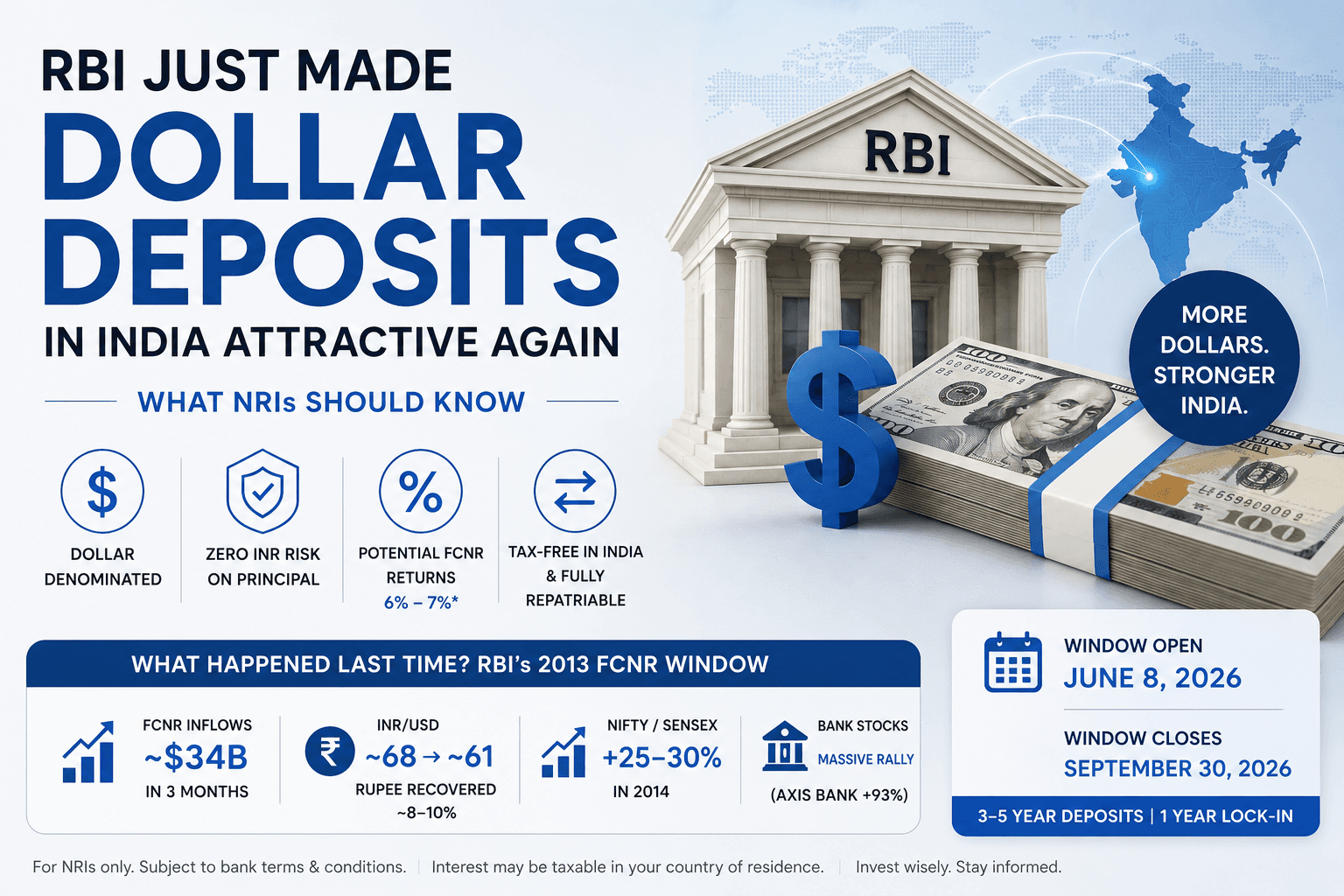
With their biggest cost gone, banks may now be able to pass it on to you. Bankers expect FCNR rates to rise by 1.5–2 percentage points — potentially to the 6–7% range in US dollars.
If that plays out: 6–7% in dollars, tax-free in India, fully repatriable, zero rupee risk — versus ~4.2% on a US Treasury. This could become one of the rare deposit products where that kind of spread exists. (Actual rates are set by each bank — they may land closer to 5.5–6% — which is why it's worth watching announcements over the coming weeks.)
The window is short: deposits must be placed between June 8 and September 30, 2026, with a one-year lock-in.
Can you do a carry trade on this?
Short answer: in principle, yes — and it was widely discussed during the 2013 window.
A carry trade means borrowing money where it's cheap and investing it where it earns more, pocketing the difference. Normally, a USD–INR carry trade is risky because the rupee can fall and erase your profit. But FCNR removes that — you borrow dollars and earn dollars, so there's no currency leg at all.
The idea: an NRI in Dubai borrows at ~5% for three years and places the money in a higher-yielding FCNR deposit. If rates land near 7%, that's a ~2% spread — and on borrowed money layered over your own capital, the return on capital can rise meaningfully. This was widely discussed during the 2013 window, particularly among Gulf-based NRIs.
Our honest caution: leverage cuts both ways. Your borrowing rate may be floating, banks can change lending terms, and the one-year lock-in limits your exit. This is for sophisticated investors who understand the risks — talk to an advisor first.
What happened the last time RBI did this?
This is a rerun of RBI's famous 2013 move, when the rupee had crashed to 68.85 and panic was in the air. One table tells the story:
What happened after RBI's 2013 FCNR window?
Metric | 2013 → 2014 |
|---|---|
INR/USD | ~68 → ~61 (rupee recovered ~10%) |
Nifty / Sensex | +25–30% in 2014 |
Bank stocks | Massive rally (Axis Bank +93%) |
FCNR inflows | ~$34 billion in 3 months |
History never repeats exactly (2014 also had a landmark election and falling oil prices). But the mechanics are the same: dollars flow in → rupee stabilises → banks get cheap deposits → markets breathe easier. We're already seeing early signs — bank stocks jumped 2–4% the day the guidelines dropped, and analysts estimate this package could attract $40–50 billion.
Here's the elegant part for you: whatever the rupee does, your FCNR deposit doesn't care. If inflows strengthen the rupee, your other India investments (mutual funds, stocks, property) gain in dollar terms. If the rupee weakens, your FCNR money is untouched. Heads you're fine, tails you're fine.
What should you do now?
Banks will announce their new FCNR rates over the coming weeks, and in 2013 the best action came mid-window as banks competed. Two practical steps:
Get investment-ready now. Pivot Money handles NRI KYC and account readiness 100% digitally — no India trip, no paperwork.
Watch the rates. We're building a bank-by-bank FCNR rate tracker and will alert our community as rates land.
If you've got 3-year-plus dollar savings sitting at 4%, this is the one to read up on before September 30.
Book a free 1:1 with our NRI advisory team
Pivot Money is a SEBI-Registered Investment Adviser and AMFI-registered Mutual Fund Distributor. This article is educational, not investment advice. Rates are indicative and set by individual banks. Past performance (including 2013–14) doesn't guarantee future results. Leveraged strategies carry significant risk. Interest may be taxable in your country of residence — please check locally.