Article
Jan 24, 2026
Insurance vs Investments: Why Mixing Them Is One of the Costliest Financial Mistakes Indians Make (2026)
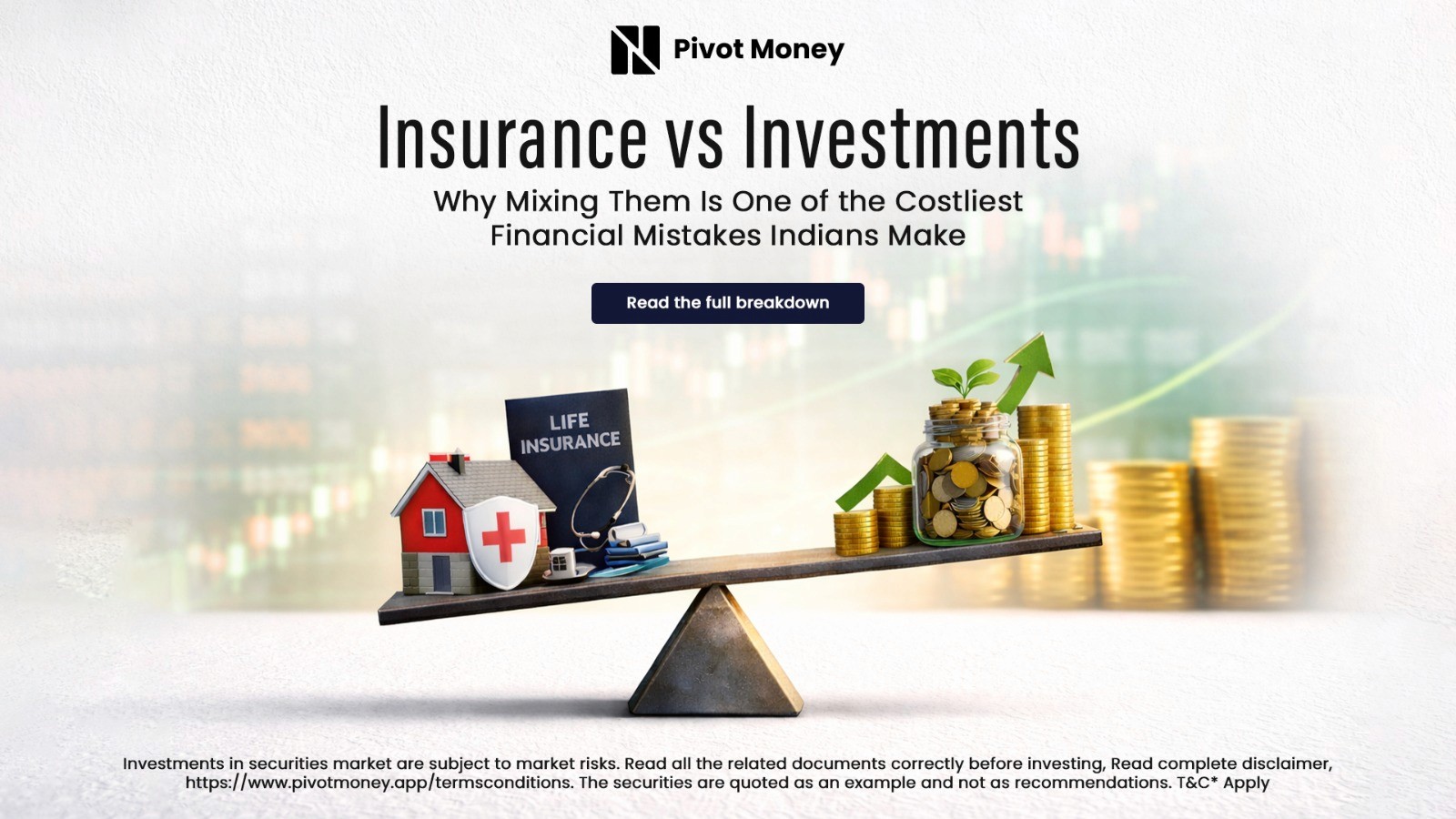
If you’ve grown up in India, or grown up around Indian financial advice, chances are you’ve heard this:
“This policy gives insurance and great returns.”
It sounds responsible. It sounds efficient.
It sounds like you’re being smart with money.
In reality, this mindset is one of the most expensive financial mistakes Indians and NRIs make.
Because insurance and investments solve two completely different problems.
When you blur that line, you usually end up:
Under-insured
Under-invested
And confused about why your money isn’t working harder
Let’s demystify what insurance is for, what investments are for — and why keeping them separate is one of the smartest financial decisions you can make.
What Insurance Is Actually For
Insurance exists for one primary reason:
👉 To protect your family from financial catastrophe.
That’s it.
Insurance is not designed to:
Grow your wealth
Beat inflation
Build a retirement corpus
Create long-term returns
Its job is to transfer risk, not create wealth.
That’s why the most effective insurance products are:
Term life insurance
Health insurance
Critical illness and disability cover
They are boring by design.
And that’s a good thing.
What Investments Are Actually For
Investments exist for a completely different reason:
👉 To grow your money and beat inflation over time.
Investments are meant to:
Build long-term wealth
Fund retirement
Create financial independence
Grow with economic growth
That’s why long-term investments typically include:
Equity mutual funds
Index funds
ETFs
Retirement-focused portfolios
Their job is not to provide protection.
Their job is to compound.
The Costly Confusion: Mixing Insurance and Investments
Here’s where most people go wrong.
Products that combine insurance and investments — like traditional endowment plans and ULIPs — promise to do both.
In reality, they usually do neither well.
Common problems:
Low life cover relative to premium
High commissions and hidden charges
Poor long-term returns
Complex structures that are hard to exit
You often end up paying a lot for:
Too little insurance
Too weak investment performance
It feels disciplined.
But mathematically, it’s inefficient.
ULIP vs Term + Mutual Funds: A Clean Comparison
Here’s a simple side-by-side that shows why separating protection and growth usually wins:
Feature | ULIP / Endowment Plan | Term Insurance + Mutual Funds |
Primary purpose | Tries to combine protection + investment | Separate protection and growth |
Life cover | Low relative to premium | High cover at low cost |
Investment returns | Typically 5–7% long-term | Potential 10–12%+ long-term |
Charges & commissions | High and complex | Low and transparent |
Flexibility | Low (lock-ins, surrender penalties) | High (change funds, adjust SIPs) |
Transparency | Low (hard to track real performance) | High (clear NAVs, statements) |
Tax efficiency | Often marketed, but inefficient | Clean and optimizable |
Portability (for NRIs) | Poor | Strong |
Outcome | Under-insured + under-invested | Properly insured + better compounding |
A Simple Example Most Families Relate To
Two people, same income, same goals.
Person A (Mixed Approach)
Buys a ₹20,000/month ULIP or endowment
Gets ~₹25–30 lakh life cover
Earns ~5–6% long-term returns
Person B (Separated Approach)
Buys ₹1 crore term insurance for ~₹2,000/month
Invests remaining ₹18,000/month into equity funds
Targets 10–12% long-term returns
After 20 years:
Person B has significantly higher wealth
Person B has 4× better insurance cover
Person B has more flexibility and clarity
Same cash outflow.
Completely different financial outcomes.
Why This Confusion Is So Common in India (and Among NRIs)
There are structural reasons this problem persists:
Agents are paid higher commissions on bundled products
Complexity makes it harder to compare outcomes
Returns are shown in absolute numbers, not real CAGR
“Tax-saving” labels are used as marketing hooks
Over time, this created a culture where:
Insurance was sold as an investment.
And investments were expected to provide protection.
Neither role was served well.
The Right Mental Model: Protection First, Growth Second
A cleaner way to think about your finances:
Step 1: Build a protection wall
Term life insurance
Health insurance
Emergency fund
Step 2: Build a growth engine
Equity mutual funds
Index funds
Long-term investment portfolios
Different tools.
Different jobs.
Better outcomes.
Why This Matters Even More for NRIs
For NRIs and global Indians, the stakes are higher.
You often deal with:
Cross-border income
Different currencies
Family financial dependence in India
Complex tax and residency rules
Mixing insurance and investments adds:
Structural inefficiency
Poor visibility
Hard-to-manage products across borders
Separating protection and growth gives you:
Clarity
Flexibility
Better long-term outcomes
The Thought-Leader Conclusion
Insurance is about protecting your downside.
Investments are about growing your upside.
When you force one product to do both, you usually sacrifice both.
The smartest financial plans are not complicated.
They are cleanly structured.
Protect first.
Then compound.
That separation alone can add years to your financial freedom — and crores to your long-term wealth.