Article
Jan 8, 2026
Banking, Investing & Taxation for NRIs (2026)
The Complete Guide to NRE, NRO, FCNR, PIS vs Non-PIS, and SOA Mode (2026)
For NRIs, financial outcomes in India depend less on product selection and more on correct banking structure, regulatory compliance, and tax treatment.
Misunderstanding NRE, NRO, FCNR, or PIS rules often leads to excess tax, blocked repatriation, and operational friction.
This all-in-one guide covers:
NRE vs NRO vs FCNR accounts
Uses and taxation of each
Repatriation rules
PIS vs Non-PIS investing
SOA mode for mutual funds
A clear banking + investing decision flow
SEO-optimized FAQs
Who This Guide Is For
This guide applies if you:
Are an NRI or OCI
Earn income outside India
Maintain bank accounts in India
Invest or plan to invest in Indian assets
Want compliant, tax-efficient structures
NRE, NRO, and FCNR Accounts Explained
1. NRE Account (Non-Resident External)
Purpose
To park foreign income remitted to India.
Key Characteristics
Maintained in INR
Funded only by foreign income
Fully repatriable (principal and interest)
Taxation
Interest is fully tax-free in India
No TDS applies
Best Used For
Investing in Indian mutual funds and equities
Long-term wealth building in India
Easy repatriation of funds
2. NRO Account (Non-Resident Ordinary)
Purpose
To manage income earned in India.
Examples
Rental income
Pension
Dividends
Sale proceeds of Indian assets
Key Characteristics
Maintained in INR
Used only for India-sourced income
Taxation
Interest is taxable in India
TDS typically at 30% + surcharge + cess
Repatriation
Limited to USD 1 million per financial year
Requires Form 15CA and Form 15CB
3. FCNR Account (Foreign Currency Non-Resident)
Purpose
To hold foreign income in foreign currency without INR conversion.
Key Characteristics
Maintained as fixed deposits only
Denominated in USD, GBP, EUR, etc.
No exchange-rate risk
Fully repatriable
Taxation
Interest is tax-free in India
No TDS applies
Best Used For
Hedging against INR depreciation
Parking surplus foreign income
Short- to medium-term capital protection
Comparison: NRE vs NRO vs FCNR
Feature | NRE | NRO | FCNR |
Currency | INR | INR | Foreign |
Source of funds | Foreign income | India income | Foreign income |
Interest tax | Tax-free | Taxable | Tax-free |
TDS | No | Yes | No |
Repatriation | Fully allowed | USD 1M/year | Fully allowed |
FX risk | Yes | Yes | No |
Step 1: Banking Foundation for Investing
Use NRE for investments wherever possible
Use NRO strictly for India-sourced income
Use FCNR to manage currency risk on foreign income
Correct segregation simplifies taxation and repatriation.
Step 2: What Are You Investing In?
NRIs typically invest in:
Indian mutual funds
Indian listed shares (direct equity)
The regulatory treatment for these two asset classes differs materially.
PIS vs Non-PIS Investing
What Is PIS?
PIS (Portfolio Investment Scheme) is an RBI-regulated mechanism that allows NRIs to invest in Indian listed shares directly.
Under PIS:
Every trade is reported to RBI
Investment limits are monitored by a designated bank
Demat, trading, and bank accounts are tightly linked
PIS applies only to direct equity shares.
It does not apply to mutual funds.
How Many PIS Accounts Can an NRI Have?
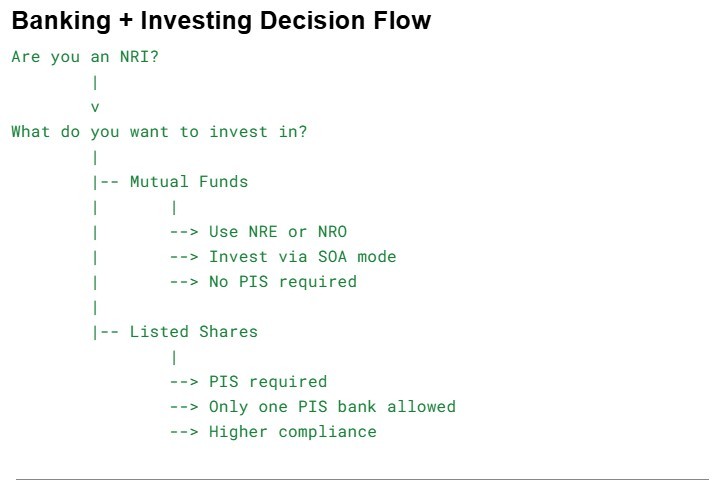
An NRI is permitted to maintain only one active PIS account at any given time across all banks.
Implications:
All PIS trades must route through one designated bank
Multiple PIS accounts are not permitted
Changing banks requires closure of the existing PIS approval
This restriction is a key source of operational complexity.
Why the PIS Process Is Complex
Common challenges include:
Dependence on a single bank
Restricted broker choice
Trade settlement delays
Reconciliation issues
RBI investment cap monitoring
Corporate action mismatches
Difficulty switching banks
Additional bank charges
Non-PIS Investing Explained
Non-PIS investing refers to NRI investments that fall outside the PIS framework.
Key points:
Mutual funds do not require PIS
No RBI trade reporting
Lower operational dependency on banks
SOA Mode: Investing Without PIS or Demat
What Is SOA Mode?
SOA (Statement of Account) mode means mutual fund units are held directly with the AMC or registrar, without a Demat account.
Why SOA Mode Works Well for NRIs
No PIS required
No Demat account required
No RBI reporting
Lower operational friction
Simpler taxation and repatriation
Clean ownership records
SOA mode is regulator-approved and widely used for NRI mutual fund investing.
Banking + Investing Decision Flow
Taxation Overview for NRIs
Bank Interest
NRE interest: Tax-free
FCNR interest: Tax-free
NRO interest: Taxable with TDS
Investments
Mutual funds: TDS applies at source
Direct equity: Capital gains tax applies
Tax treaties may offer relief based on country of residence
Summary: Best-Practice Structure for Most NRIs
Banking: NRE + NRO (and FCNR where relevant)
Investing: Mutual funds via SOA mode
PIS: Only if direct equity exposure is required
This setup minimizes tax friction and compliance risk.
FAQs
Is interest on FCNR accounts taxable in India?
No. Interest on FCNR deposits is tax-free for NRIs.
Can NRIs freely repatriate money from India?
Yes, from NRE and FCNR accounts. NRO repatriation is capped at USD 1 million per year.
Is PIS mandatory for NRIs?
PIS is mandatory only for direct equity investments in Indian listed shares.
Can NRIs invest in mutual funds without Demat?
Yes. Mutual funds can be held in SOA mode without Demat or PIS.
How many PIS accounts can an NRI have?
Only one active PIS account across all banks.
Does LRS apply to NRIs?
No. LRS applies only to resident Indians.
Final Takeaway
For NRIs, clean banking structure and the right investment mode matter more than product selection.
Using NRE and FCNR accounts appropriately, avoiding unnecessary PIS complexity, and investing via SOA mode creates a compliant, tax-efficient foundation for long-term wealth in India.