Article
Feb 4, 2025
India vs US vs Canada: Where Does Real Long-Term Wealth Compound Better?

Introduction
For many NRIs, the US feels safe, Canada feels stable, and India feels risky. But long-term wealth doesn’t compound where things feel comfortable—it compounds where growth sustains over time.
Growth sets the ceiling for compounding
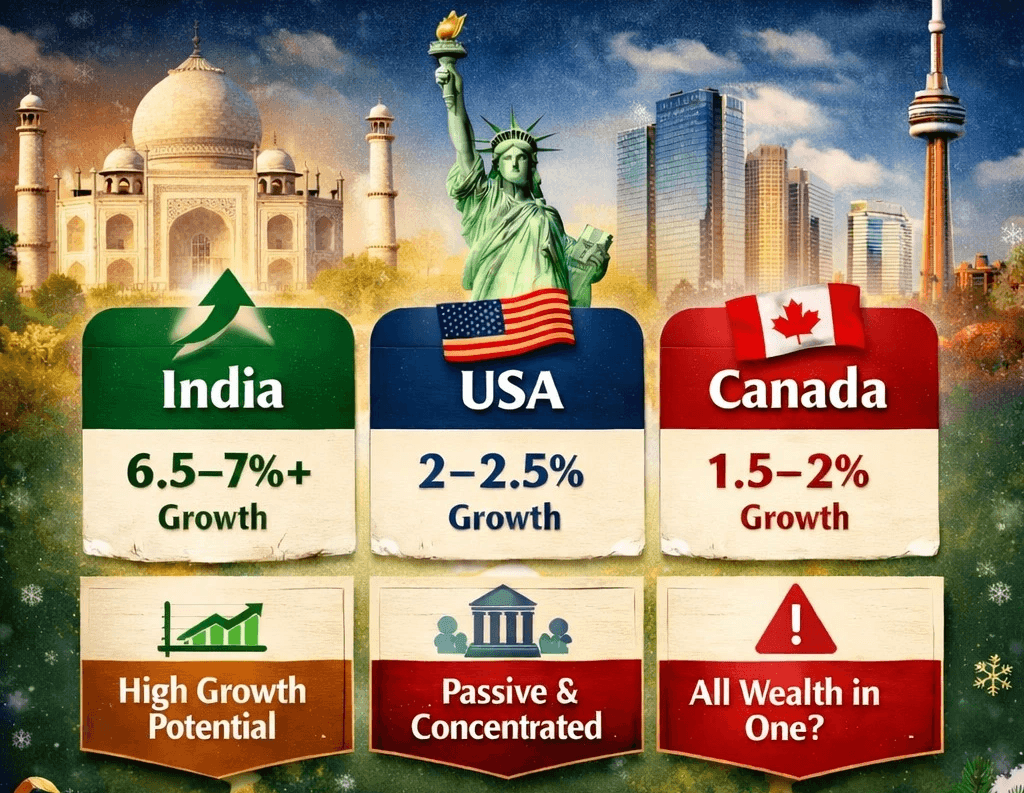
According to the IMF (World Economic Outlook, 2024), India is growing at 6.5–7% annually and recently crossed 8%+. In comparison, the United States grows at ~2–2.5%, and Canada at ~1.5–2%. Over 20–30 years, this gap compounds into very different outcomes.
Mature markets protect wealth; growing markets multiply it.
Stability vs upside
The US and Canada are mature markets—large companies are already large, so returns tend to be steady but incremental. India is still scaling across manufacturing, digital payments, infrastructure, and consumption, which creates higher volatility but also higher long-term upside (World Bank, RBI).
Where economies are still scaling, earnings grow faster.
Passive abroad vs active in India
US and Canadian portfolios are heavily passive and increasingly concentrated—the top 10 stocks now make up ~35% of the S&P 500 (S&P Dow Jones Indices). India remains a market where active managers add value, especially as global liquidity tightens.
When money stops being free, selection matters.
The real answer
It’s not India versus the US or Canada. Developed markets offer stability. India offers growth. For NRIs with cross-border lives, keeping all wealth in one country is the real risk.
Global assets give stability. A strategic, meaningful India allocation provides growth and compounding advantage. For most NRIs, that balance often means holding passive, low-cost exposure in their country of residence while actively allocating to high-quality, higher-risk Indian funds—where professional management and structural growth can work hardest over time.
The right mix isn’t about geography; it’s about aligning your money to where the world is still expanding.